नेपालको शिक्षा 'प्रेसर कुकर' होइन, 'सपोर्टिभ सिस्टम' हुनुपर्छ
विद्यार्थीलाई दोष दिनुभन्दा पहिले हामीले आफ्नो प्रणालीलाई हेर्नुपर्छ।
By Dr. ND LamaJuly 27, 2026
नेपालका धेरै शिक्षाविद्हरूले हाम्रो शिक्षा प्रणाली राम्रो छ, गुणस्तरीय छ र विदेशी शिक्षाभन्दा कमजोर छैन भन्ने तर्क गर्नुहुन्छ। यो तर्क पूर्ण रूपमा गलत होइन। नेपालमा मेहनती विद्यार्थी, सक्षम शिक्षक र केही उत्कृष्ट शैक्षिक संस्थाहरू अवश्य छन्। तर केही राम्रा उदाहरणका आधारमा सम्पूर्ण प्रणालीका कमजोरीलाई बेवास्ता गर्नु पनि उचित हुँदैन।
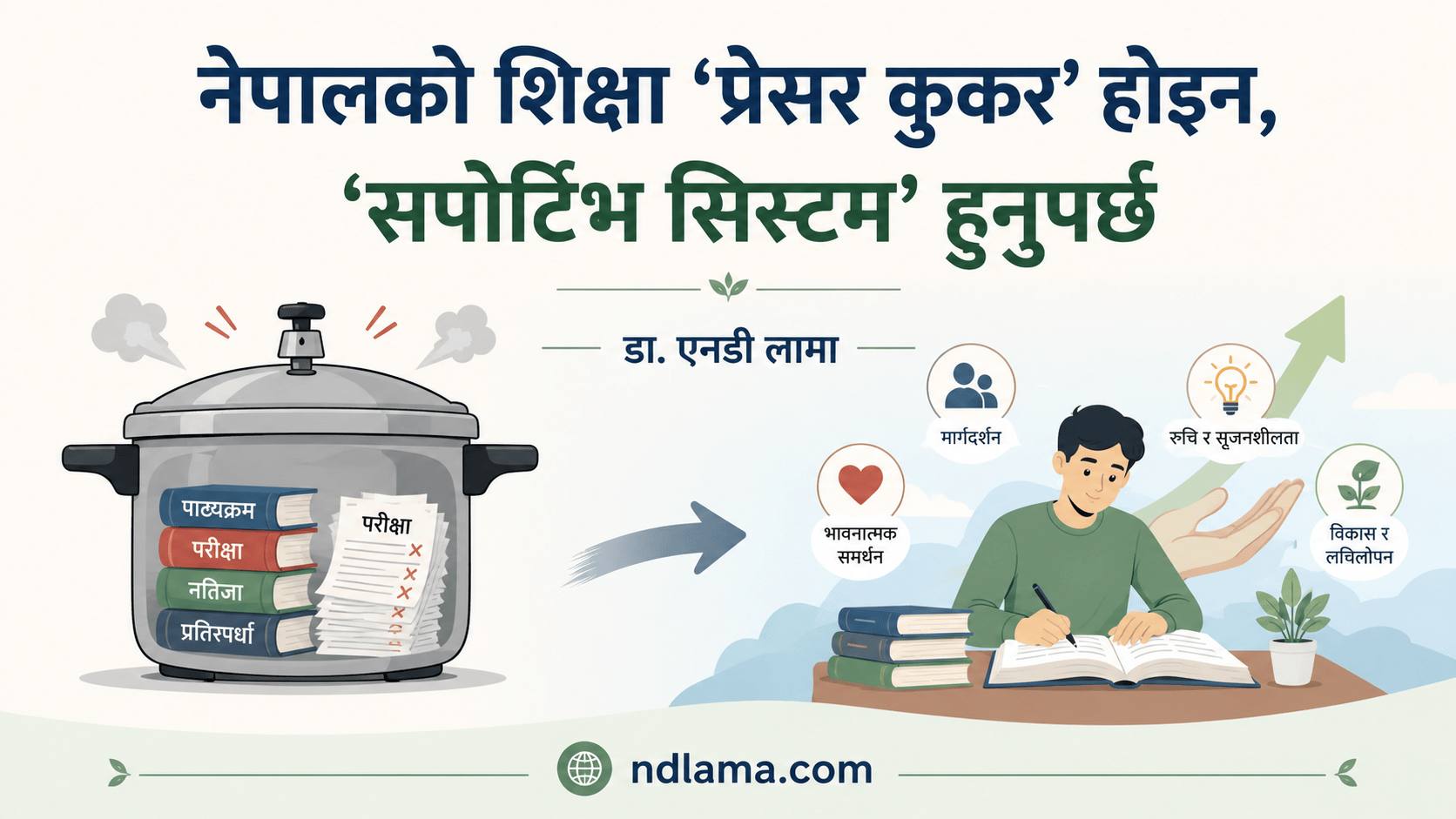
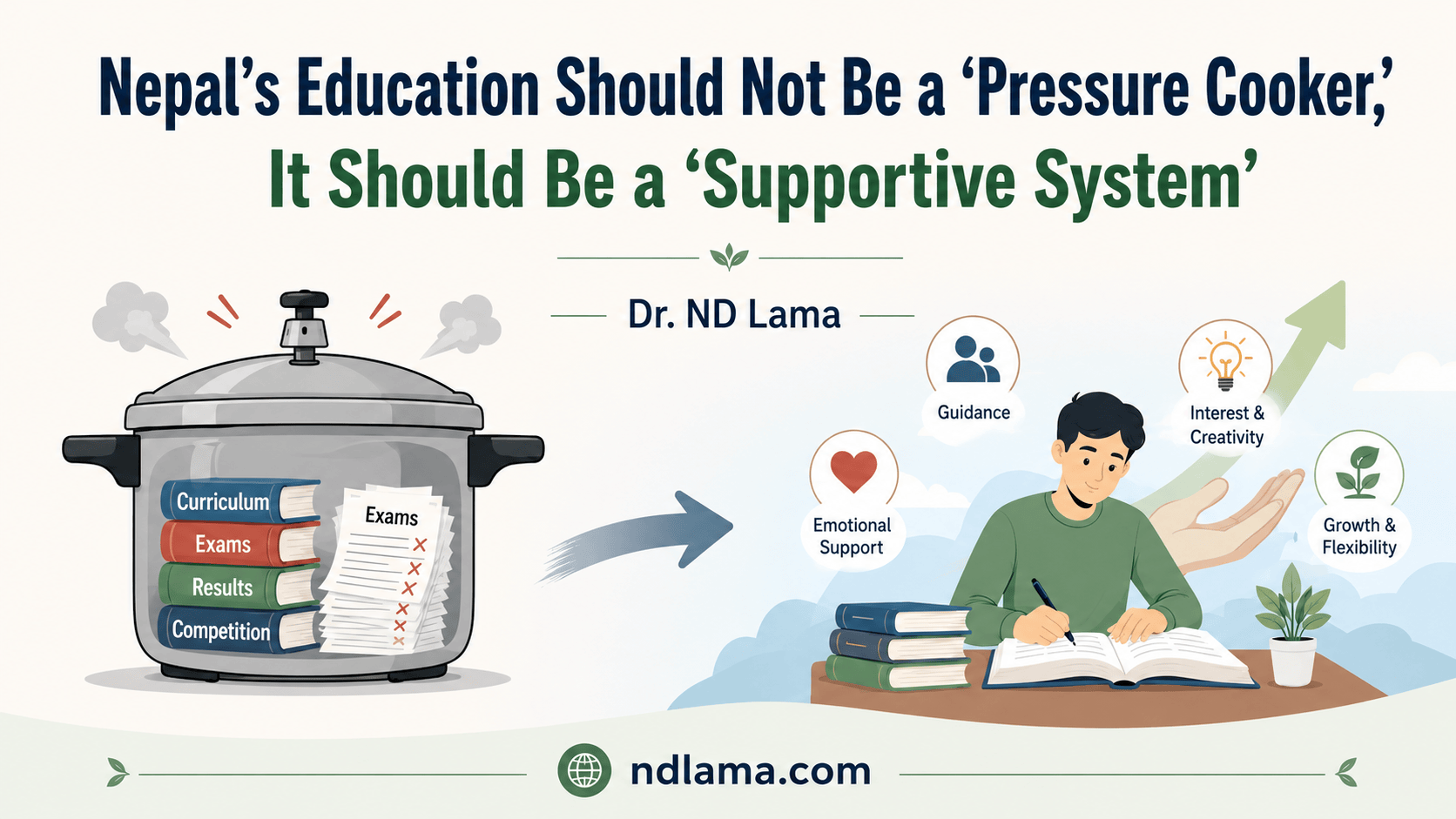
मैले आफ्नो पुस्तक Beyond Exams मा नेपालको शिक्षा प्रणालीलाई प्रेसर कुकरसँग तुलना गरेको छु। प्रेसर कुकरभित्र ताप र दबाब बढ्दै जान्छ। त्यसैगरी हाम्रो शिक्षा प्रणालीमा पनि परीक्षा, अङ्क, प्रतिस्पर्धा, प्रमाणपत्र र निश्चित समयभित्र निश्चित उपलब्धि हासिल गर्नुपर्ने दबाब लगातार बढिरहेको छ।
विद्यार्थीलाई आफ्नो रुचि पत्ता लगाउन, गल्ती गर्न, विषय परिवर्तन गर्न, बिस्तारै सिक्न वा नयाँ दिशामा अगाडि बढ्न पर्याप्त अवसर दिइँदैन। सबै विद्यार्थीलाई एउटै गति, एउटै परीक्षा र एउटै मापदण्डबाट मूल्याङ्कन गर्ने प्रयास गरिन्छ।
मेरो व्यक्तिगत अनुभव
मैले नेपालमा पनि अध्ययन गरेको छु र अमेरिकाबाट पनि उच्च शिक्षा हासिल गरेको छु। मेरी छोरी अहिले अमेरिकामा नर्सिङ अध्ययन गर्दैछिन्। हाम्रो टोलीले भारतमा पनि केही विद्यार्थीलाई नर्सिङ अध्ययन गर्न सहयोग गरिरहेको छ।
यी अनुभवबाट मैले एउटा महत्त्वपूर्ण कुरा बुझ्न पाएँ—शिक्षाको गुणस्तर केवल पाठ्यक्रम कति कठिन छ भन्ने कुराले निर्धारण हुँदैन। विद्यार्थीलाई कति सहयोग, लचकता, मार्गदर्शन र अवसर दिइन्छ भन्ने कुरा अझ महत्त्वपूर्ण हुन्छ।
मेरी छोरीले नेपालमा नर्सिङ अध्ययन गर्न प्रयास गर्दा सीमित सिटका लागि अत्यन्त धेरै प्रतिस्पर्धा थियो। उनी सानो उमेरमा अमेरिकामा पढेकी भएकाले नेपाली र सामाजिक अध्ययनजस्ता विषयमा उनको ग्रेड अन्य प्रतिस्पर्धी विद्यार्थीको जस्तो उच्च थिएन। तर कुनै विद्यार्थीको वास्तविक क्षमता दुई–चार विषयका अङ्कले मात्र पूर्ण रूपमा देखाउँदैन।
पछि उनले अमेरिकामा नर्सिङ अध्ययन गर्ने अवसर पाइन्। त्यहाँको प्रणालीमा विद्यार्थीले आवश्यक विषय पूरा गर्दै भविष्यमा आफ्नो शैक्षिक दिशा परिवर्तन गर्न सक्छ। नर्सिङ अध्ययन गरेपछि थप पूर्वशर्त पूरा गरेर अन्य स्वास्थ्यसम्बन्धी उच्च अध्ययनतर्फ जाने बाटो पनि खुला रहन्छ।
नेपालमा भने एकपटक कुनै विषय रोजेपछि विद्यार्थी प्रायः त्यही सीमाभित्र बाँधिन्छ। विषय परिवर्तन गर्न, अध्ययन रोकिएपछि पुनः सुरु गर्न वा वैकल्पिक बाटो अपनाउन कठिन हुन्छ।
विद्यार्थीहरू विदेश किन जान्छन्?
सबै विद्यार्थी पैसा धेरै भएर, विदेश घुम्न वा प्रतिष्ठाका लागि मात्र विदेश गएका हुँदैनन्। धेरै विद्यार्थी लचिलो, समयमै सञ्चालन हुने र सहयोगी शिक्षा प्रणाली खोजिरहेका हुन्छन्।
उनीहरूले यस्ता प्रश्न सोधिरहेका छन्:
परीक्षा समयमै हुन्छ कि हुँदैन?
नतिजा समयमै आउँछ कि आउँदैन?
अनलाइन अध्ययन गर्न पाइन्छ कि पाइँदैन?
विषय परिवर्तन गर्ने अवसर छ कि छैन?
अध्ययनसँगै काम गर्न मिल्छ कि मिल्दैन?
शिक्षक र संस्थाले विद्यार्थीलाई सहयोग गर्छन् कि केवल दबाब दिन्छन्?
विदेशी विश्वविद्यालयबाट सम्बन्धन प्राप्त कलेजतर्फ विद्यार्थीको आकर्षण बढ्नु पनि हाम्रो शिक्षा प्रणालीका लागि एउटा सन्देश हो। विदेशी सम्बन्धन भएका सबै कलेज उत्कृष्ट छन् भन्ने होइन। त्यहाँ पनि कमजोर संस्था हुन सक्छन्। तर विद्यार्थी र अभिभावकले किन ती संस्थालाई रोजिरहेका छन् भन्ने प्रश्नलाई हामीले गम्भीरतापूर्वक बुझ्नुपर्छ।
गाली गरेर समस्या समाधान हुँदैन
विदेशी सम्बन्धन भएका कलेजलाई खत्तम भनेर गाली गर्नु, विद्यार्थीलाई दोष दिनु वा अभिभावकले नबुझेर त्यस्ता कलेज रोजे भन्नु सजिलो छ। तर त्यसले समस्या समाधान गर्दैन।
हामीले सोध्नुपर्ने प्रश्न हो: विद्यार्थीले हाम्रो विश्वविद्यालयमा नपाएको के कुरा अर्को प्रणालीमा पाइरहेको छ? समयमै परीक्षा र नतिजा, लचिलो अध्ययन, प्रविधिको प्रयोग, अनलाइन शिक्षा, अन्तर्राष्ट्रिय पाठ्यक्रम, विद्यार्थीमैत्री सेवा वा विषय परिवर्तनको अवसर—यीमध्ये कुन कुराले विद्यार्थीलाई आकर्षित गरिरहेको छ?
विद्यार्थीले हाम्रो प्रणाली छोडिरहेका छन् भने रिसाउने होइन, त्यसको कारण बुझ्नुपर्छ।
विश्वविद्यालयहरूले के सुधार गर्नुपर्छ?
नेपालका विश्वविद्यालयहरूले पुरानो संरचना र ढिलासुस्तीबाट बाहिर निस्कनुपर्छ। पाठ्यक्रम निर्माणदेखि परीक्षा, नतिजा र प्रमाणपत्र वितरणसम्मका प्रक्रिया छिटो र पारदर्शी बन्नुपर्छ।
विद्यार्थीलाई सहयोग गर्ने प्रणाली निर्माण गर्न कम्तीमा यी क्षेत्रमा सुधार आवश्यक छ:
समयमै परीक्षा र नतिजा
अनलाइन तथा मिश्रित अध्ययनको व्यवस्था
विषय परिवर्तन गर्न मिल्ने लचिलो संरचना
विद्यार्थी परामर्श र मार्गदर्शन
सीप, रुचि र क्षमतामा आधारित मूल्याङ्कन
अन्तर्राष्ट्रिय स्तरसँग मिल्ने पाठ्यक्रम
अध्ययन रोकिएका विद्यार्थीलाई पुनः प्रवेशको अवसर
काठमाडौं विश्वविद्यालयले केही क्षेत्रमा नयाँ अभ्यास गरेको देखिन्छ। त्रिभुवन विश्वविद्यालय, पोखरा विश्वविद्यालय, पूर्वाञ्चल विश्वविद्यालयलगायत अन्य संस्थाहरूले पनि विद्यार्थीको बदलिँदो आवश्यकता बुझेर छिटो सुधार गर्नुपर्छ।
निष्कर्ष
शिक्षाको उद्देश्य विद्यार्थीलाई दबाब दिएर एउटै आकारमा ढाल्नु होइन। शिक्षाले विद्यार्थीको रुचि चिन्न, क्षमता विकास गर्न, गल्तीबाट सिक्न र भविष्यको बाटो रोज्न सहयोग गर्नुपर्छ।
हाम्रो शिक्षा प्रणाली प्रेसर कुकर होइन, सपोर्टिभ सिस्टम बन्नुपर्छ।
विद्यार्थीलाई दोष दिनुभन्दा पहिले हामीले आफ्नो प्रणालीलाई हेर्नुपर्छ। विद्यार्थीहरू बाहिर गइरहेका छन् भने त्यसको अर्थ उनीहरू बिग्रिएका होइनन्; सम्भवतः उनीहरूले आफ्नो आवश्यकता पूरा गर्ने अर्को बाटो भेटिरहेका छन्।
नेपालमै यस्तो शिक्षा वातावरण निर्माण गरौँ, जहाँ विद्यार्थीले बाध्य भएर विदेश जानु नपरोस्।
तपाईंलाई के लाग्छ? नेपालको शिक्षा प्रणाली पर्याप्त विद्यार्थीमैत्री छ, कि अझै धेरै सुधार आवश्यक छ?
Many educators in Nepal argue that our education system is good, of high quality, and no weaker than education abroad. This argument is not entirely wrong. Nepal certainly has hardworking students, capable teachers, and some excellent institutions. But it is not right to ignore the weaknesses of the whole system on the basis of a few good examples.
In my book Beyond Exams, I compare Nepal's education system to a pressure cooker. Inside a pressure cooker, heat and pressure keep building. In the same way, our education system keeps piling on pressure — exams, marks, competition, certificates, and the demand to achieve fixed results within a fixed time.
Students are not given enough opportunity to discover their interests, make mistakes, change subjects, learn slowly, or move in a new direction. The system tries to evaluate every student at the same pace, with the same exam, by the same standard.
My personal experience
I have studied in Nepal and also earned higher education in the United States. My daughter is currently studying nursing in America. Our team is also supporting some students to study nursing in India.
From these experiences I understood one important thing — the quality of education is not determined only by how difficult the curriculum is. What matters even more is how much support, flexibility, guidance, and opportunity a student is given.
When my daughter tried to study nursing in Nepal, there was intense competition for the limited seats. Because she had studied in America from a young age, her grades in subjects like Nepali and Social Studies were not as high as those of other competing students. But a student's real ability cannot be fully shown by the marks in just two or four subjects.
Later she got the opportunity to study nursing in America. In that system, a student can complete the required subjects and change their academic direction later. After studying nursing, the path to other health-related higher studies also stays open by completing additional prerequisites.
In Nepal, however, once a student chooses a subject, they are often bound within that limit. It is difficult to change subjects, to restart after a break in studies, or to take an alternative path.
Why do students go abroad?
Not all students go abroad simply because they have plenty of money, to travel, or for prestige. Many students are looking for a flexible, on-time, and supportive education system.
They are asking questions like:
Will the exams be held on time or not?
Will the results come on time or not?
Can I study online or not?
Is there an opportunity to change subjects or not?
Can I work while studying or not?
Do teachers and institutions support students, or only pressure them?
The growing attraction toward colleges affiliated with foreign universities is also a message for our education system. Not all colleges with foreign affiliation are excellent — there can be weak institutions there too. But we must seriously understand why students and parents are choosing those institutions.
Blaming does not solve the problem
It is easy to insult foreign-affiliated colleges as worthless, to blame students, or to say that parents chose such colleges out of ignorance. But that does not solve the problem.
The question we should ask is: what is a student finding in another system that they did not get in our university? On-time exams and results, flexible study, use of technology, online education, an international curriculum, student-friendly services, or the chance to change subjects — which of these is attracting students?
If students are leaving our system, we should not get angry — we should understand the reason.
What must universities improve?
Nepal's universities must break out of their old structures and slowness. From curriculum design to exams, results, and the distribution of certificates, the processes must become fast and transparent.
To build a system that supports students, improvement is needed at least in these areas:
On-time exams and results
Provision for online and blended learning
A flexible structure that allows changing subjects
Student counseling and guidance
Assessment based on skills, interest, and ability
Curriculum aligned with international standards
An opportunity for students who paused their studies to re-enter
Kathmandu University appears to have adopted some new practices in certain areas. Tribhuvan University, Pokhara University, Purbanchal University, and other institutions must also understand students' changing needs and reform quickly.
Conclusion
The purpose of education is not to pressure students and mold them into a single shape. Education should help students recognize their interests, develop their abilities, learn from their mistakes, and choose their path for the future.
Our education system should not be a pressure cooker; it should be a supportive system.
Before blaming students, we must look at our own system. If students are going abroad, it does not mean they are spoiled; perhaps they have simply found another path that meets their needs.
Let us build such an educational environment within Nepal itself, where students do not have to go abroad out of compulsion.
What do you think? Is Nepal's education system student-friendly enough, or is much more reform still needed?